Dust alternative

Dust alternative: an agent workspace on company knowledge, or a project room with meetings and a board?

Look for a Dust alternative if the credit meter on each seat worries you, or if your team decides in calls and wants a record. Stay with Dust if you build agents on connected company knowledge and want a public price and a choice of models. Roomcord is a shared project room where people and AI teammates work from the same conversation, files and meetings. It is not an agent builder.

The short answer

Look at Roomcord if:

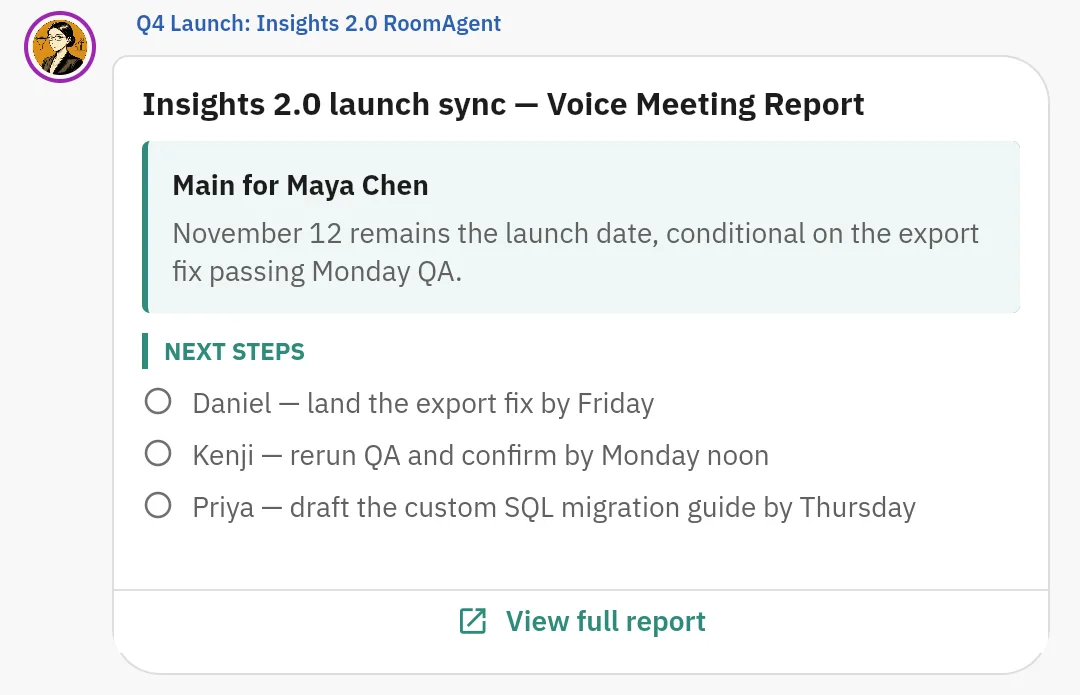
  • Your team decides in chat and calls, and you want the meeting recorded and its report posted where the agents work.
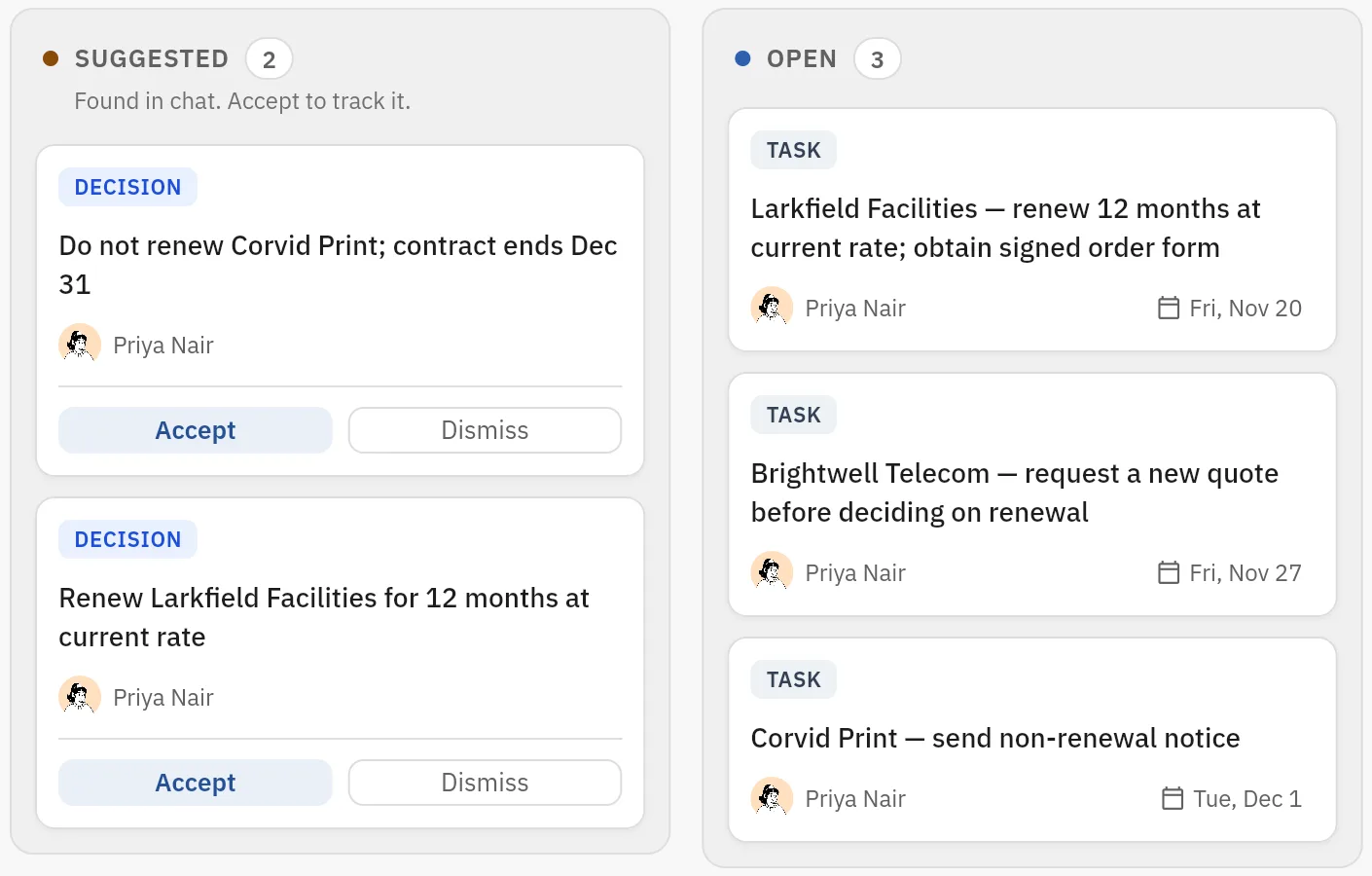
  • You want decisions and tasks from the conversation on a board, where a person accepts each one.
  • You want to agree where agents run. Roomcord is designed for infrastructure your company controls.

Stay with Dust if:

  • Your main job is to build agents on connected company knowledge, such as Slack, Notion, Google Drive and GitHub.
  • You want a public price and a self-serve start. A Pro seat is €24 per month on yearly billing, as of November 2026.
  • You want to choose the model for each agent, from more than 20 models.

What this page is: a dated comparison by Bewize, the maker of Roomcord. Dust prices and limits link to their sources. Roomcord claims follow a check of the production build on November 15, 2026. Its availability section lists what is in development. Reviewed November 15, 2026.

Why teams look for a Dust alternative in 2026

“Dust moved from fair-use messages to a credit meter”

A pricing tracker records the change on June 24, 2026. Before it, Pro was €29 per user per month with unlimited messages under fair use. Now each seat has a monthly allowance: 8,000 credits on Pro and 40,000 on Max (pricing page). Credits do not move between users, do not roll over and are not refundable (credit rules).

“What happens when a Pro seat runs out of credits?”

A response in progress finishes. After that, a Pro or Max member draws on a shared workspace pool. On the Business plan an admin buys that pool in advance, as top-up packages. Dust’s credit management page states: “PAYG is not available on the Business plan.” Scheduled agents stop too: “A trigger stops running once the pool it charges is out” (trigger page).

“Dust Business connects up to 3 data sources”

Dust’s home page advertises 70+ connectors. The plan table on the pricing page lists, for Business, up to 3 connectors, 5 remote MCP servers and 5 Spaces.

“Our decisions happen in meetings”

A Pod holds conversations, tasks and files (Pods overview). The Pods pages that we read name no meeting recorder. Agents can read transcripts from other tools: the changelog added a Fireflies connection on October 14, 2026. Someone must run and connect that recorder.

What Dust costs now

Dust pricing is a seat fee with a credit allowance for each seat. List prices as of November 2026:

Seat or planList priceIncludedLimit or meter
Free seat€0Trial use500 credits, one time
Pro seat€24 per seat per month billed yearly, €30 billed monthly20+ models, custom agents, Pods, schedules, SSO, US or EU data residency8,000 credits per seat per month
Max seat€120 billed yearly, €150 billed monthlyThe same features40,000 credits per seat per month
EnterpriseBy quoteAdds SCIM, audit logs, custom data retention, single-tenant deployment, unlimited connectorsWorkspace-pooled credits, Pay As You Go overage

Sources: Dust’s pricing page and credit management page, checked November 15, 2026. Prices exclude VAT. The page showed euros, and the tracker above lists the same numbers in US dollars. Business is for teams of up to 100 people.

A 25-person team on Pro seats pays €7,200 a year on yearly billing, or €9,000 on monthly billing. With five Max seats it is €12,960 on yearly billing. Dust gives no fixed number of messages per credit, so measure one real month before you commit to a year.

Roomcord has no public price list and no self-serve signup. Pricing is by quote, after a demo on your own workflow. Ask for the included usage and the overage terms in writing.

Dust vs Roomcord at a glance

QuestionDustRoomcord
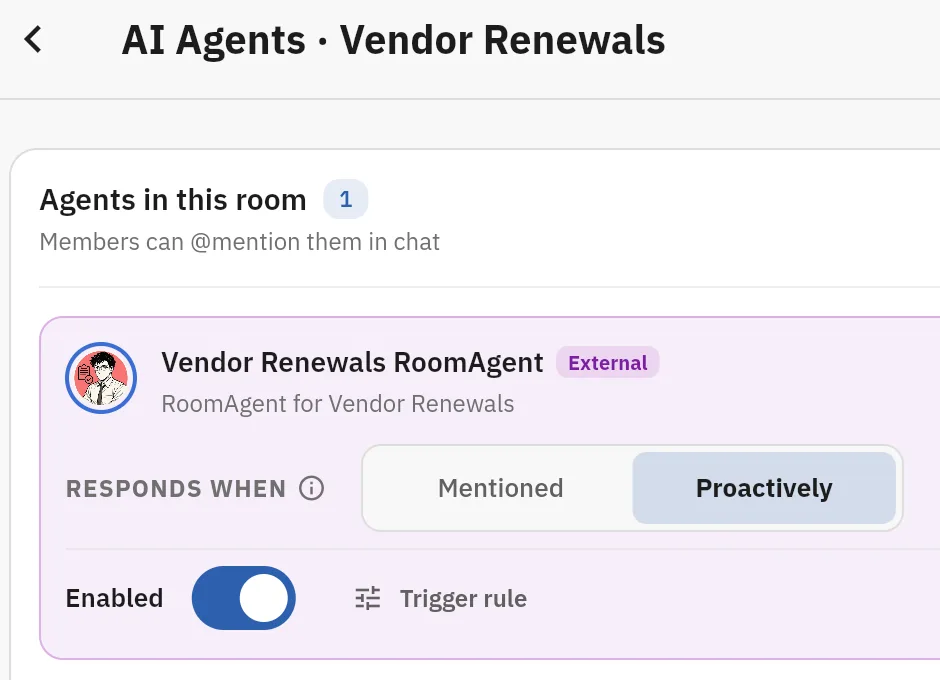
Where do agents work?In the Dust workspace and in Slack. In a Pod, people and agents share conversations, tasks and files. Mention an agent and it answers there.In a shared project room, as named participants. Mention one in chat or in a thread and it answers there, or it answers proactively. A2A-compatible external agents can join.
What does the AI know?Connected company data, in Spaces with permissions. In a Pod: its files and indexed conversations.The room: conversation, files, meeting recaps and a Room Context document. We claim no connector catalog.
What happens after a meeting?The Pods pages name no meeting recorder (November 2026). Agents can read transcripts from connected tools such as Fireflies.Meeting Mode records on mobile or web, up to two hours. Roomcord transcribes the recording, and a recap is posted in the room. The recap proposes names and dates, and a person confirms them.
How is work tracked?Pod tasks in a list grouped by assignee: Open, In progress, Done. People and agents create tasks.A room Board. Cards found in chat wait as Suggested until a person accepts them. Automatic reminders and follow-up are in development.
What are the limits or meters?Credits per seat each month: 8,000 on Pro, 40,000 on Max. No rollover. Then a prepaid workspace pool.No public meter or price. Usage terms are in the quote. We do not claim unlimited usage.
Where does it run?A hosted service with US or EU data residency. Single-tenant deployment on Enterprise. SOC 2 Type II. Its security page names no self-hosted option.Designed for private cloud or data-center infrastructure that the company controls. Placement is agreed per deployment. No compliance certificate is claimed here.

Sources: Dust’s pricing page, Pods overview, Tasks page and security page. Not an independent benchmark.

The same job in both products

The job: a five-person operations team renews vendor contracts. It decides in a Monday call and in chat, and someone must follow each decision.

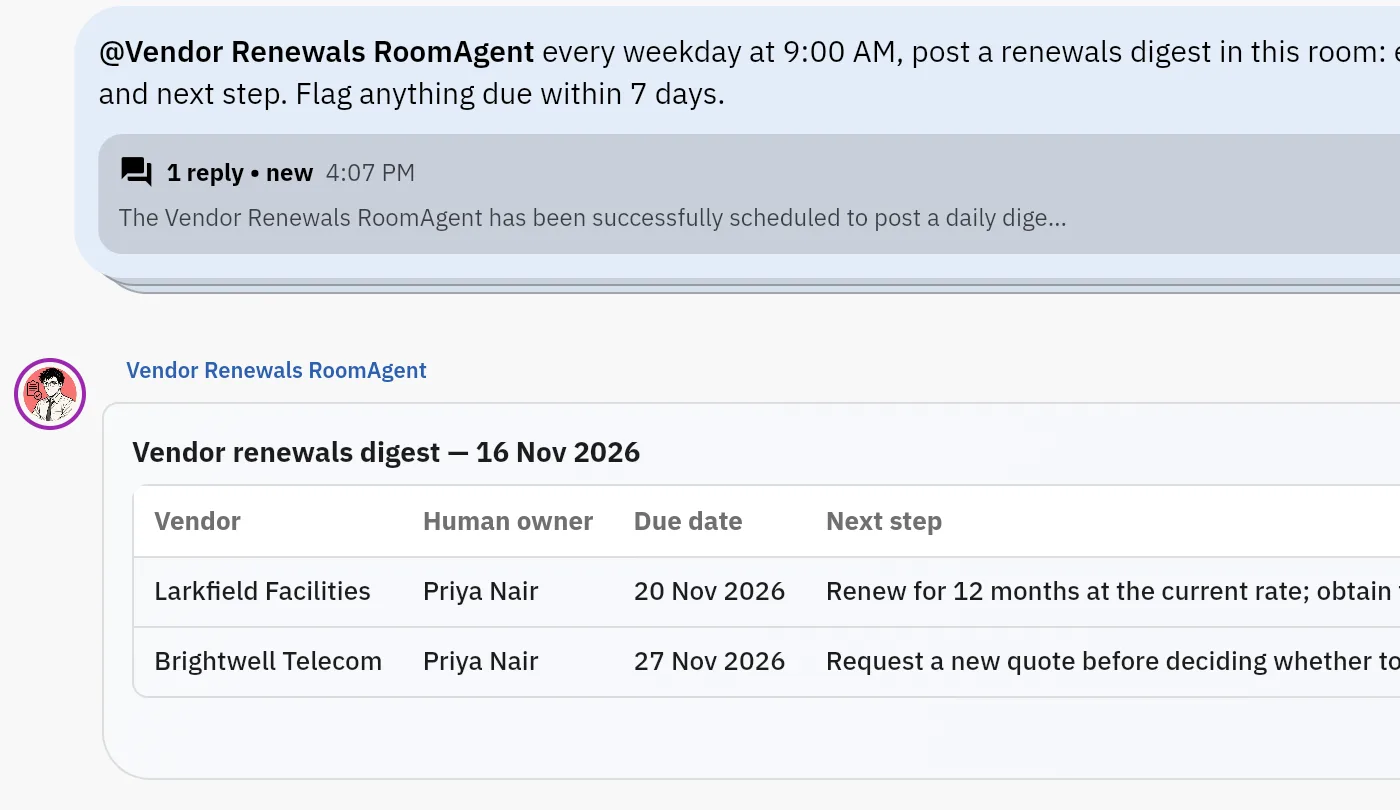
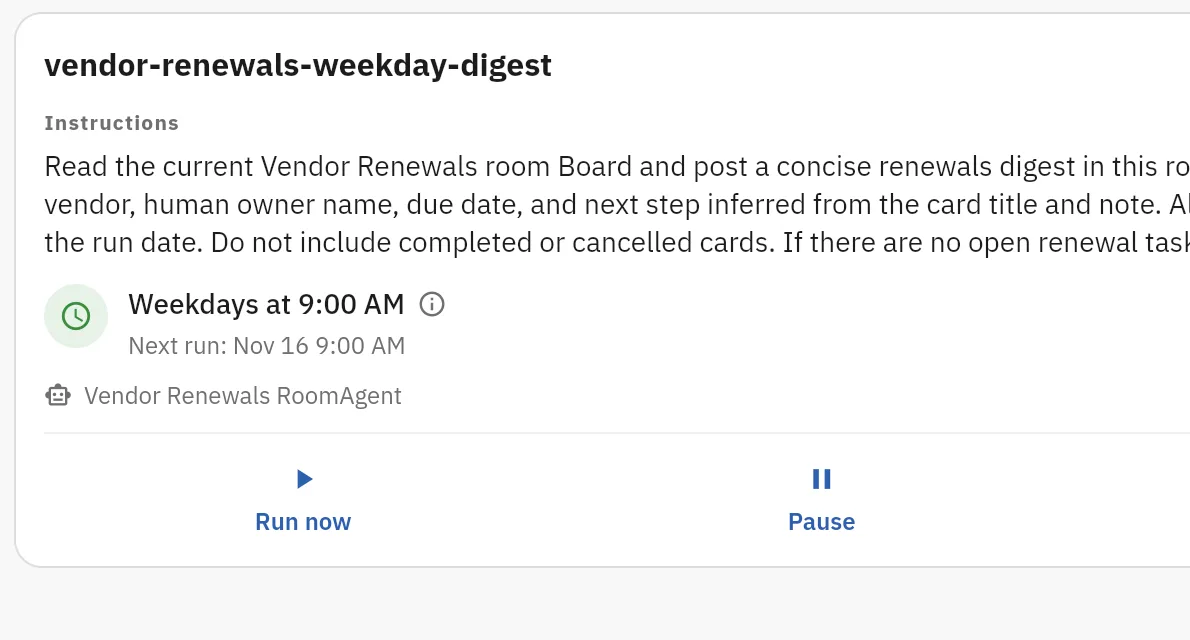
In Dust. The team opens a Pod for renewals and links the contract folder from its company data. Anyone mentions an agent in a Pod conversation and asks for the status. The answer draws on the Pod’s files and past conversations. An agent on a schedule can post a brief in the Pod each weekday.

The Monday call stays outside Dust unless a recorder such as Fireflies is connected.

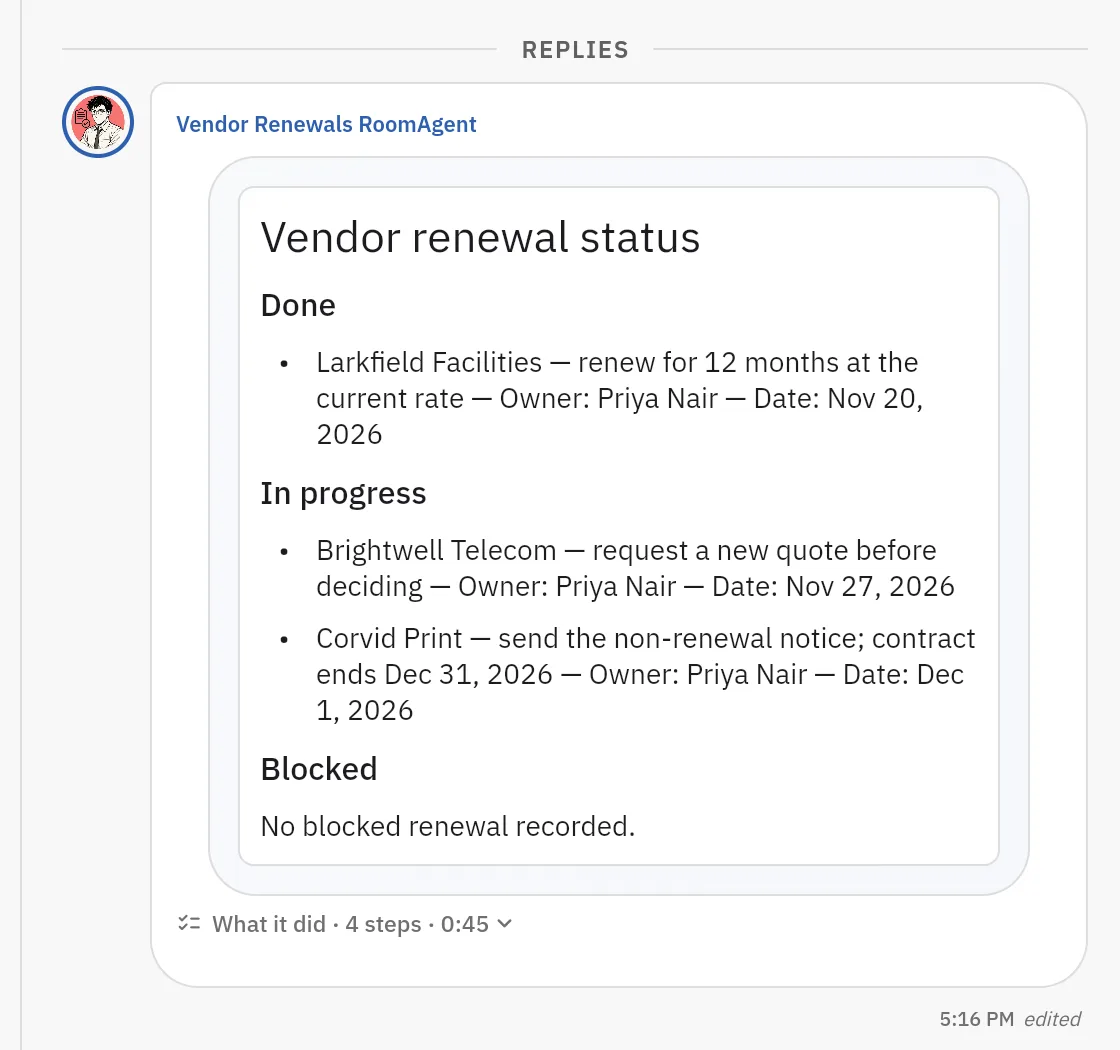
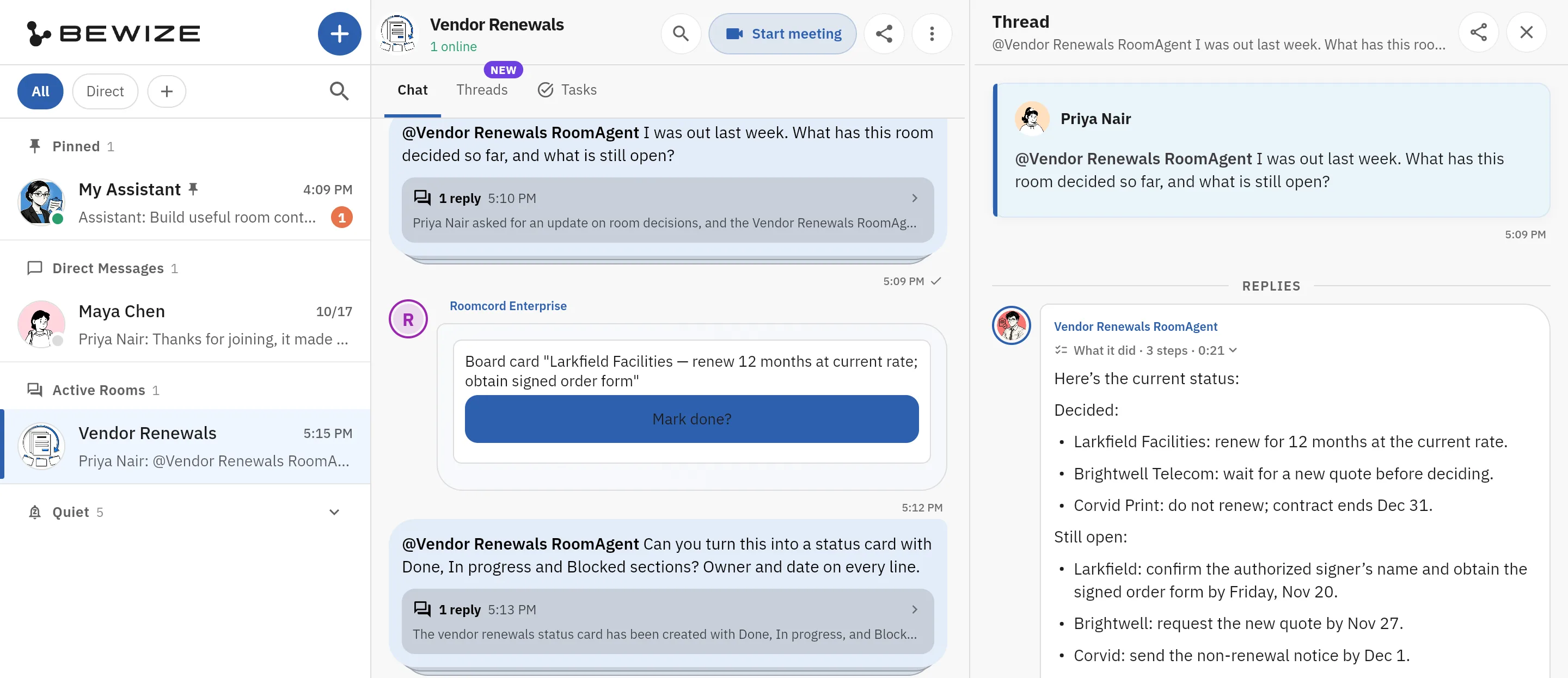
In Roomcord today. The team works in one renewals room. Chat and files are there, and Meeting Mode records the Monday call, with a recap posted in the room. Decisions found in chat appear on the Board as suggested cards, and a person accepts or dismisses each one. Someone asks the agent in chat for a digest each weekday.

What is manual: the recap proposes names and dates from the conversation, and a person confirms them and chases them. Automatic tracking, reminders and chasing are in development. A contract in another tool is not in the room until someone adds it.

Where Dust is stronger

  • Agent building. Custom agents with skills, knowledge and tools, plus multi-agent workflows (pricing page).
  • Connected company knowledge. Connectors for Slack, Notion, GitHub and Google Drive, Spaces for permissions, and MCP for other tools.
  • Model choice. More than 20 models from five providers, chosen per agent. Roomcord’s default offering uses the latest top-tier models from OpenAI.
  • A public price and a self-serve start. A Free seat with 500 credits, then paid seats. With Roomcord you talk to us first.
  • Published security statements. SOC 2 Type II, GDPR, and “Your data is never used to train models” (security page). Roomcord publishes no such list.

What Roomcord does not replace

  • Dust’s agent builder, connectors and model catalog. Keep them for agents that work across company knowledge. Roomcord agents work from what is in the room.
  • Your project tracker. The room Board holds decisions and tasks, and suggested cards wait for a person to accept them. Automatic reminders, approval ballots and follow-up are in development. See Roomcord vs Asana.
  • The cost of model usage. Agents spend usage in every product. Roomcord’s usage and overage terms are in your quote.

Run it next to Dust first

  1. Pick one recurring workflow: a weekly status, a review or a handoff.
  2. Open one room for it. Add the people who do that work and one AI teammate.
  3. Keep everything else in Dust. Migrate nothing.
  4. After three or four cycles, count what the agent got right, what people corrected and what stayed manual.

The cost: a second app for that workflow. We claim no Dust integration. The test is a pilot agreed with us after a demo. Roomcord has no self-serve signup.

Leaving Dust: what to check first

  • Term. After you cancel, the subscription stays active until the end of the billing period (subscriptions page).
  • Refunds. An annual seat that a member leaves is not refunded. Credits are not refundable. Top-up credits are valid for one year.
  • Deletion. By default, Dust deletes the workspace data 30 days after the billing period ends: conversations, agents, skills, data sources, Spaces and API keys. Your originals in connected tools are not affected.
  • Export. The subscriptions page describes no export of conversations or agents. Ask Dust in writing before you cancel.

Questions people ask about Dust and Roomcord

How much does Dust cost in 2026?
A Pro seat is €24 per month billed yearly, with 8,000 credits a month. A Max seat is €120, with 40,000 credits (Dust’s pricing page, November 2026, VAT excluded). Enterprise is by quote.
How do Dust credits work?
Each message costs token credits plus action credits: 0, 1 or 3 for each tool action. Seat credits reset each month, do not roll over and do not move between users (credit rules, November 2026).
What is a Dust Pod?
A shared workspace inside Dust where people and agents work on one goal, with conversations, tasks and files. Dust announced Pods on May 29, 2026 (changelog).
Dust vs Glean: what is the difference?
Dust is a workspace for building agents on connected company knowledge, with public seat prices. We cover Glean on a separate page.
Is Roomcord a Dust alternative?
For team work that happens in conversation and meetings, with agents in the room, yes. For an agent builder on connected company knowledge with a choice of models, no. See the other comparisons or enterprise agent platforms.
How much does Roomcord cost?
Roomcord has no public price list, no free tier and no self-serve signup. Pricing is by quote, after a demo on your own workflow.
What works in Roomcord today?
Shared rooms, chat, files, meeting capture with a report, AI teammates that answer in the room, the room Board with suggested cards that a person accepts, scheduled agent jobs, and room access for A2A-compatible external agents. Automatic reminders and follow-up, approval ballots and boss view are in development. Pilot scope is agreed for each team.

Bring one recurring workflow

Pick one piece of work that your team now runs in a Dust Pod or in separate agent chats each week. We show it in a Roomcord room: what works today, what stays manual, what is in development. Pilot scope and price follow.

+1 332 2081410
[email protected]

Request a demo

Share a little context. Our team will reply by email to arrange the next step.