
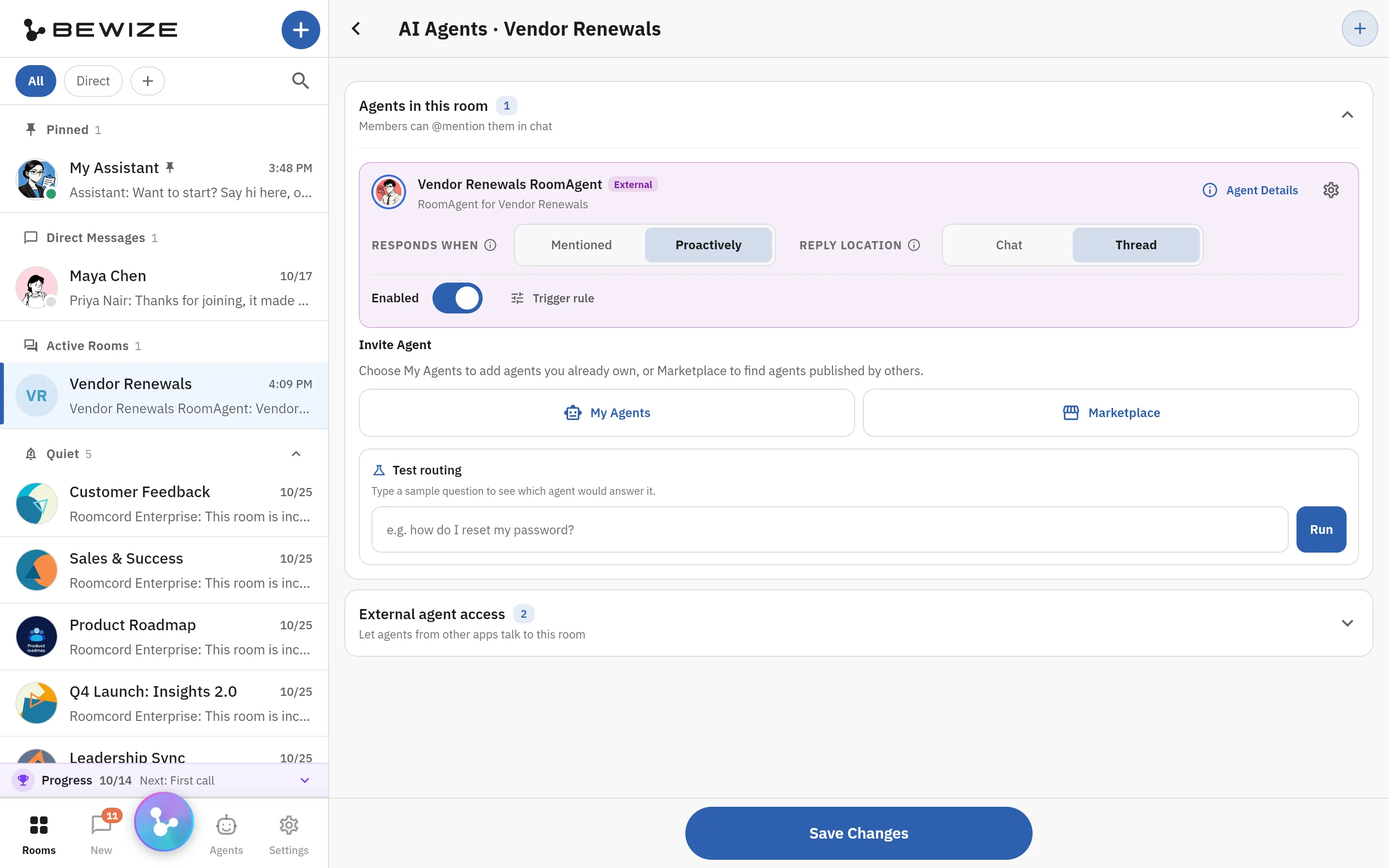
Each agent has an Enabled switch, per room
The AI Agents screen of one room, as the room owner sees it. The agent has an Enabled switch and answers when Mentioned or Proactively. The full screen also sets the reply location: Chat or Thread.
Atlassian Rovo alternative
Look for an Atlassian Rovo alternative if your work happens in conversations, meetings and files outside Jira and Confluence, and a credit meter on chat does not fit. Stay with Rovo if your work lives in Jira and Confluence, where search and summaries cost no credits. Roomcord is a shared project room where people and AI teammates work from the same conversation, files and meetings. It does not replace Jira or Confluence.
Look at Roomcord if:
Stay with Atlassian Rovo if:
What this page is: a dated comparison by Bewize, the maker of Roomcord. Atlassian prices and limits link to their sources. Roomcord claims follow a check of the production build on November 15, 2026. Its availability section lists what is in development. Reviewed November 15, 2026.
As of November 2026, a Jira or Confluence user gets 25, 70 or 150 Rovo credits per month on Standard, Premium or Enterprise. One Rovo Chat message costs 10 credits. Credits do not roll over, and billing for extra usage starts on December 3, 2026.
Atlassian’s support page says: “Extra usage is enabled by default, and admins can set spending limits”. Its pricing FAQ says: “Extra usage billing requires opt-in.” Both sentences were live on November 15, 2026. Check your admin console before December 3.
One Hacker News user described Rovo as “intrusive AI buttons that suddenly appeared everywhere without any warning”. Another wrote that it is “impossible to disable it until you have a very certain, very expensive plan”. Atlassian’s documentation describes an off switch: an organization admin can block Rovo per app.
On August 5, 2026, PromptArmor reported that Rovo could be manipulated through indirect prompt injection into sending Jira and Confluence data to an attacker’s server. This is PromptArmor’s report. We did not test it. Ask Atlassian for the current status.
Rovo comes with paid Jira, Confluence and collection plans as a monthly credit allowance. The table shows credits per user per month, as of November 2026, from Atlassian’s Rovo credits page.
| Plan tier | Jira or Confluence | Teamwork or Service Collection | Quick chat messages per user |
|---|---|---|---|
| Standard | 25 | 250 | 2 or 25 |
| Premium | 70 | 700 | 7 or 70 |
| Enterprise | 150 | 1,500 | 15 or 150 |
A 25-person team. On Jira Standard the pool is 625 credits: 62 quick chat messages a month for the whole team. On Jira Premium it is 1,750 credits, or 7 messages per person. After that, each quick message costs $0.10. At 5 messages per person per working day (21 days, 2,625 messages), extra usage on Jira Premium is about $245 a month.
Seat prices are not in this table. Atlassian raised Cloud list prices on October 13, 2026, so check your renewal quote.
Roomcord has no public price list and no self-serve signup. Pricing is by quote, after a demo on your own workflow. Ask for the included usage and the overage terms in writing.
| Question | Atlassian Rovo | Roomcord |
|---|---|---|
| Where do agents work? | Inside Jira, Confluence and other Atlassian apps: in Rovo Chat, search and tickets. | In a shared project room. People @mention an agent, and the room sees the reply. |
| What does the AI know? | Your Atlassian data through the Teamwork Graph. A third-party review also lists connectors to other tools. | The room: conversation, files, meeting recaps and a Room Context document. No native Jira or Confluence integration. |
| What are the limits or meters? | 25 to 1,500 credits per user per month, 10 per chat message, no rollover, $0.01 per extra credit from December 3, 2026. | No public meter and no public price. Terms are set by quote. |
| Where does it run? | Atlassian Cloud. Atlassian has announced data residency for Rovo. | Designed for private cloud or data-center infrastructure that the company controls. Placement is agreed per deployment. No compliance certificate is claimed here. |
| Who controls the AI? | An organization admin blocks Rovo per app. User-group control is documented for Enterprise. | The room owner sets each agent per room: on or off, answers when mentioned or proactively, replies in chat or in a thread. An agent can be removed from a room. |
| What does it not do? | Rovo Chat without credits: each user message is a billable event. Teamwork Collection is Cloud only, with fixed apps and a one-year minimum term, per Seibert Group. | No issue tracking, sprints, service desk or wiki. Automatic reminders, approval ballots, follow-up and executive views are in development. |
The job: an operations team reviews one vendor each month. The contract is a PDF, the discussion is in chat, and the decision is made in a meeting. None of it is a Jira work item.
In Atlassian Rovo. Rovo must be on for your organization, and the outside source must be connected. This job sits outside Rovo’s free tier, so it runs on the meter.
Each message costs 10 credits, and most enriched Teamwork Graph calls cost 1 to 10 credits each. Ask Atlassian to show the connector for your file store and what one real question costs.
In Roomcord today. The vendor review has its own room. The contract is a file in the room and the discussion is the room chat. Meeting Mode records the meeting on mobile or web, up to two hours. Roomcord transcribes it, and a recap is posted in the room. Someone @mentions an agent and asks it to compare the new quote with last month’s terms.
The reply lands in the room, where a teammate can correct a wrong number. What is manual: a person adds the files. The recap proposes names and dates from the conversation, and a person confirms the decision, the owner and the date. Automatic tracking, reminders and chasing are in development.
Real screens, staging build, demo data
Captures from the Roomcord staging build, taken on November 15, 2026, with demo data: rooms of a fictional company called Lumen, and a Vendor Renewals room with fictional vendors. Half-width images are crops. A code check on the same day found the same features in the production build. A caption says plainly when something shown is still in development.
The AI Agents screen of one room, as the room owner sees it. The agent has an Enabled switch and answers when Mentioned or Proactively. The full screen also sets the reply location: Chat or Thread.
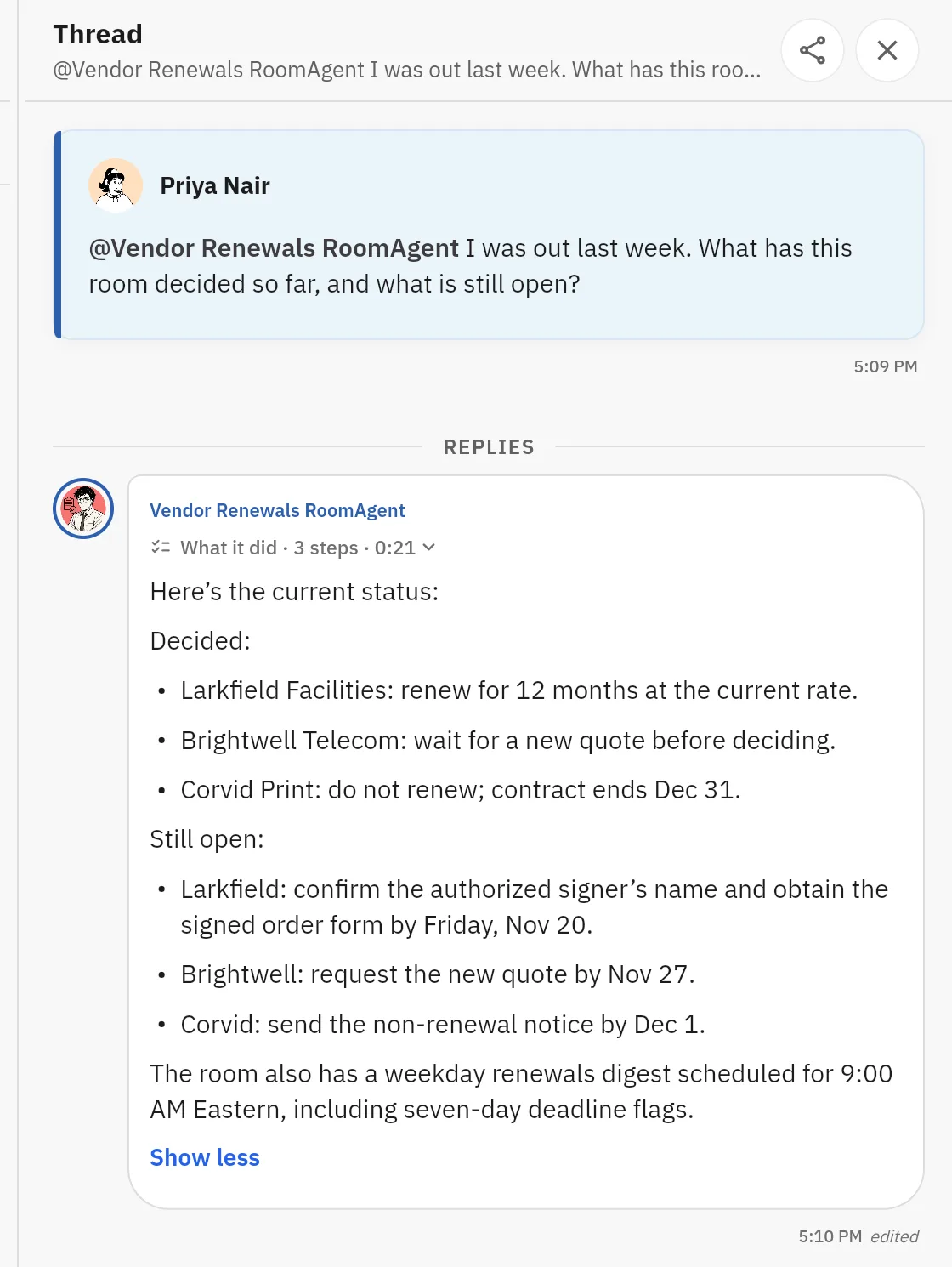
Priya asks the room agent what the room decided while she was away. The reply is a thread in the room, and a label shows what the agent did: 3 steps.
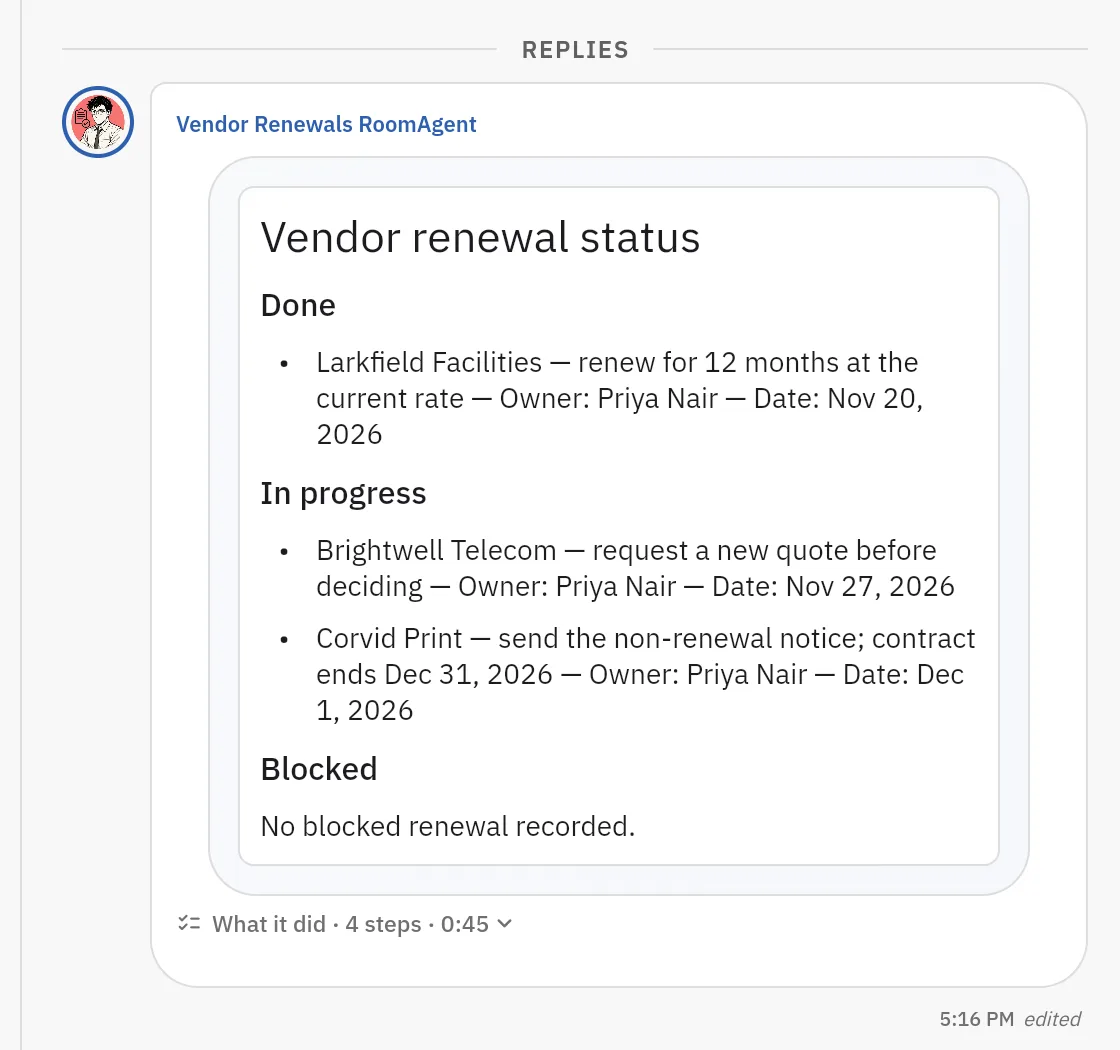
Asked for a status card, the room agent replies in the thread with Done, In progress and Blocked. Each vendor line has an owner and a date. A person checks the names and dates.
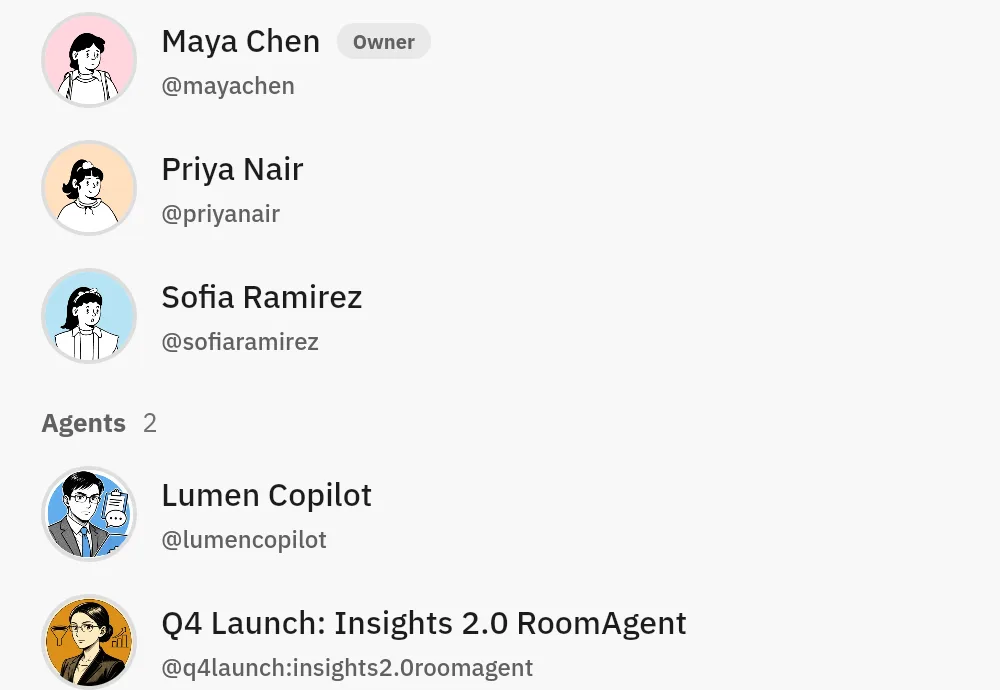
Part of the Members screen of one room: people first, then two agents by name, Lumen Copilot and the room agent.
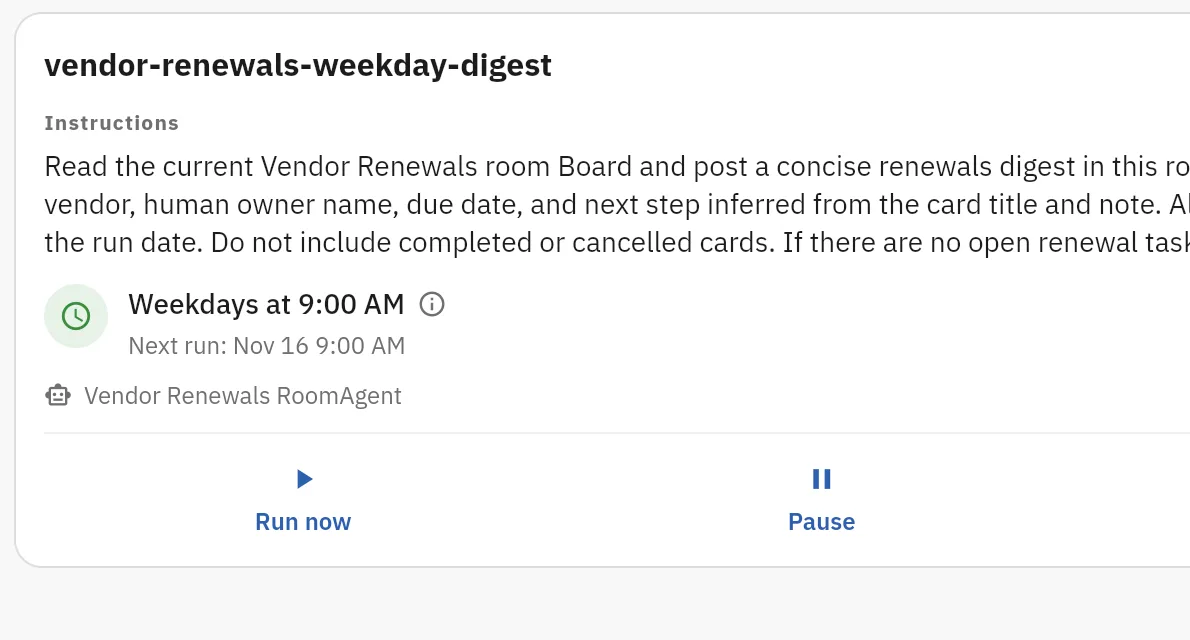
Part of an agent’s Jobs tab: one scheduled job with its instructions, Weekdays at 9:00 AM, the next run, and the actions Run now and Pause. The agent’s owner sees the jobs, and so do people the owner shared the agent’s files with.
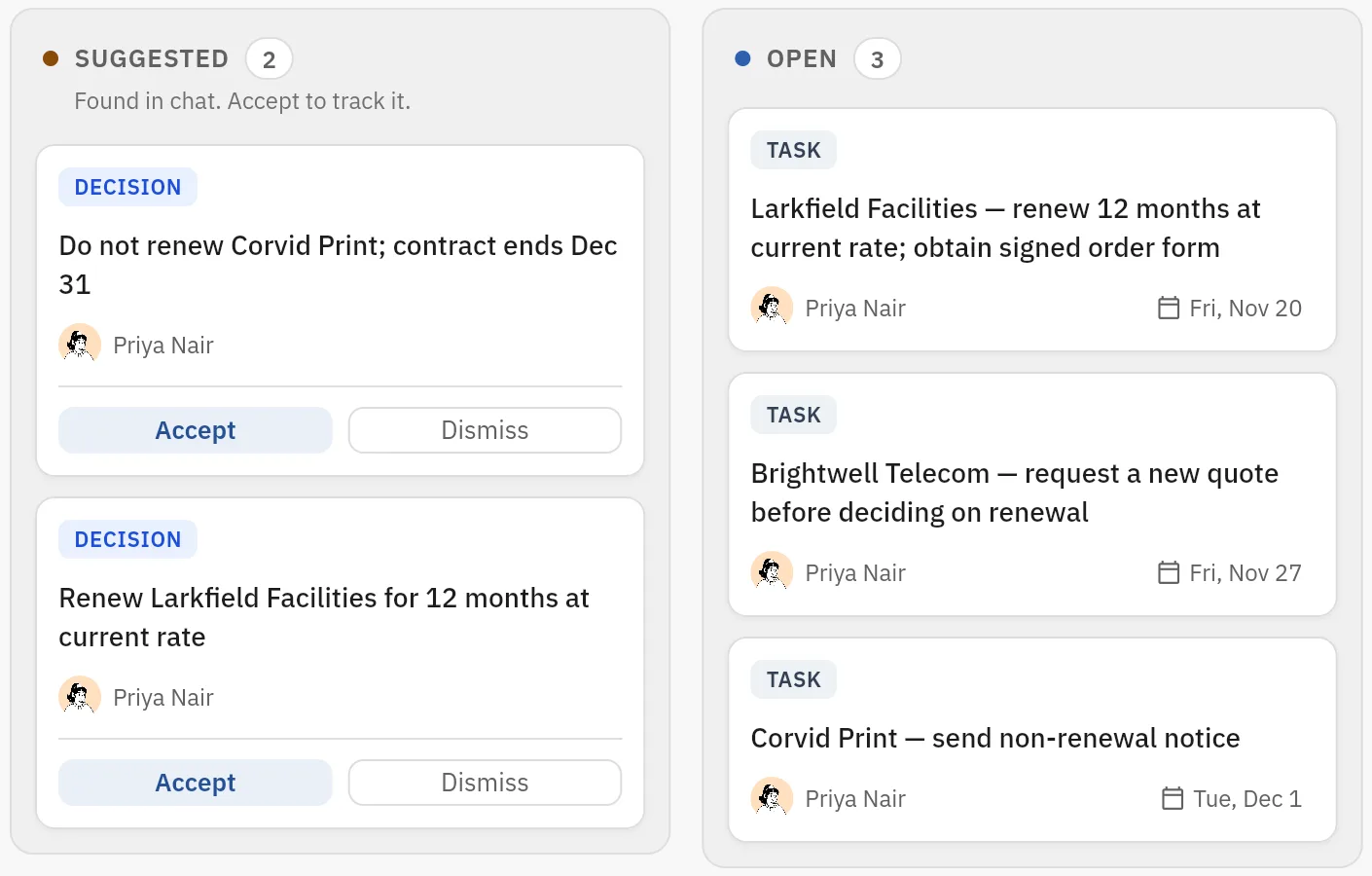
Part of the Board of a Vendor Renewals room. Two decisions found in chat wait for Accept or Dismiss. Three open tasks show an owner and a due date. Suggested cards are tracked only after a person accepts them. Automatic reminders and follow-up are in development.
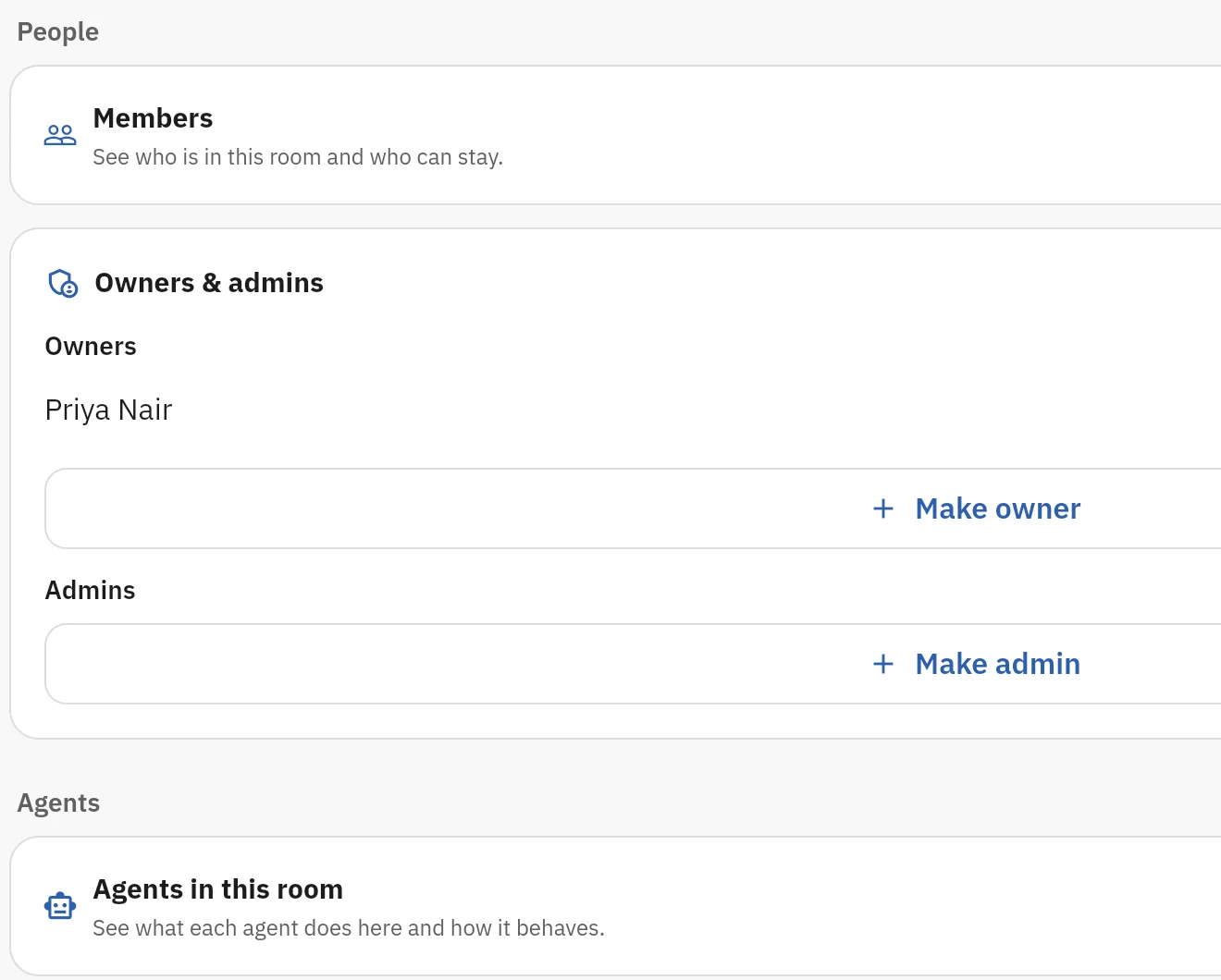
Room Settings name the room owner, with buttons to add owners and admins, and a link to see what each agent does in the room.
The cost: a second app for that workflow. The test is a pilot agreed with us after a demo. Roomcord has no self-serve signup.
Pick one meeting or handoff that happens outside Jira and Confluence. We show it in a Roomcord room: what works today, what stays manual, what is in development. Pilot scope and price follow.
Share a little context. Our team will reply by email to arrange the next step.